


One-rep max calculator
Your one-rep max (1RM) is the heaviest weight you can lift once with good form. You do not have to test it to know it: a hard set of a few reps predicts it well.
The formulas
In each formula, w is the weight lifted and r is the number of reps completed.
Epley
1RM = w × (1 + r / 30)Usually credited to Boyd Epley's 1985 Poundage Chart. At 1 rep, the calculator returns the weight itself.
Brzycki
1RM = w × 36 / (37 − r)From Matt Brzycki's 1993 article in the Journal of Physical Education, Recreation & Dance, which states it as a fraction of 1RM: 1.0278 − 0.0278 × r. The two forms are the same equation.
Lombardi
1RM = w × r0.10From Lombardi's 1989 textbook Beginning Weight Training.
How accurate are the estimates?
Good enough to track progress and set training weights, not exact. LeSuer and colleagues tested seven prediction equations on bench press, squat and deadlift and found high correlations with tested maxes, but accuracy varied by lift (deadlift was underestimated by all of them), and estimates were more accurate from sets of 10 reps or fewer. In practice:
- Use a set of about 3 to 8 reps taken close to failure with good form.
- Compare estimates from the same formula over time; the trend matters more than the number.
- Expect the formulas to disagree more as reps climb past 10.
Using your 1RM
Many programs set weights as a percentage of 1RM. Another way to set them is by effort: see RPE and RIR. Either way, the point is to keep adding a little over time: progressive overload.
Let Lift estimate it for you
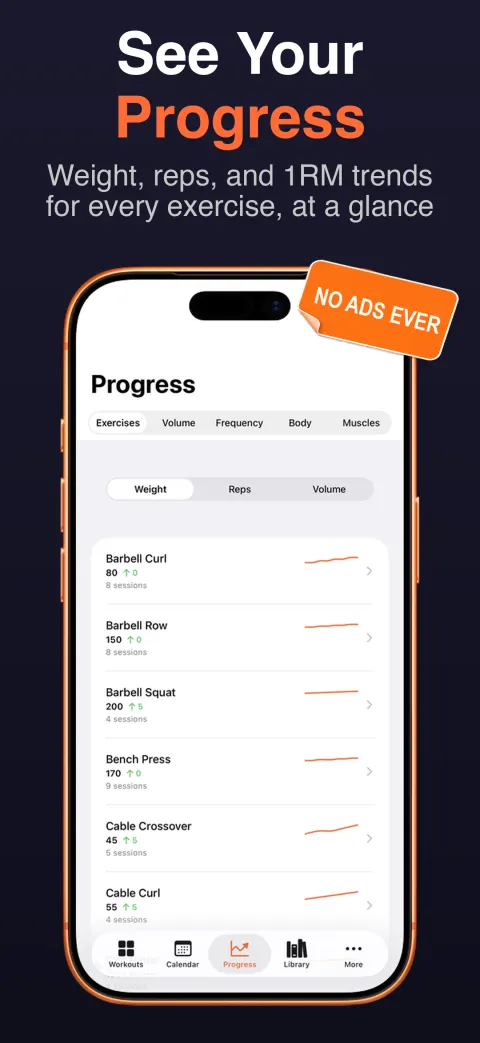
Lift Pro estimates your one-rep max from every logged set and charts it for each exercise, with five formulas to choose from.


Frequently asked questions
Which one-rep max formula is most accurate?
No single formula wins for every lift and every person. In LeSuer and colleagues' 1997 comparison of seven equations, accuracy depended on the exercise, and the estimates were better when the set was 10 reps or fewer. Averaging a few formulas is a reasonable middle ground.
Is it safe to test a true one-rep max?
A true max attempt is a skill in itself and is best done with a spotter or safety bars, after a proper warm-up. For tracking progress, an estimate from a hard set of 3 to 8 reps tells you most of what you need without the risk of a failed max.
Does this calculator save what I type?
No. The math runs in your browser. Our analytics records only that the calculator was used and which options you picked, never the weights or reps.
Can Lift estimate my one-rep max automatically?
Yes. Lift Pro estimates a one-rep max from your logged sets and charts it over time. In Lift Lab you can pick Epley, Brzycki, Lombardi, O'Conner or Wathan, or the average of all five.
Sources
- Brzycki M. Strength testing: predicting a one-rep max from reps-to-fatigue. JOPERD 1993;64(1):88-90
- LeSuer DA, McCormick JH, Mayhew JL, et al. The accuracy of prediction equations for estimating 1-RM performance in the bench press, squat, and deadlift. J Strength Cond Res 1997;11(4):211-213 (print)
- Epley B. Poundage Chart. Boyd Epley Workout. Lincoln, NE: Body Enterprises; 1985 (print)
- Lombardi VP. Beginning Weight Training. 1989 (print)